Foreclosure Support › Questions
Will you owe money after foreclosure? It depends on your province — and your mortgage
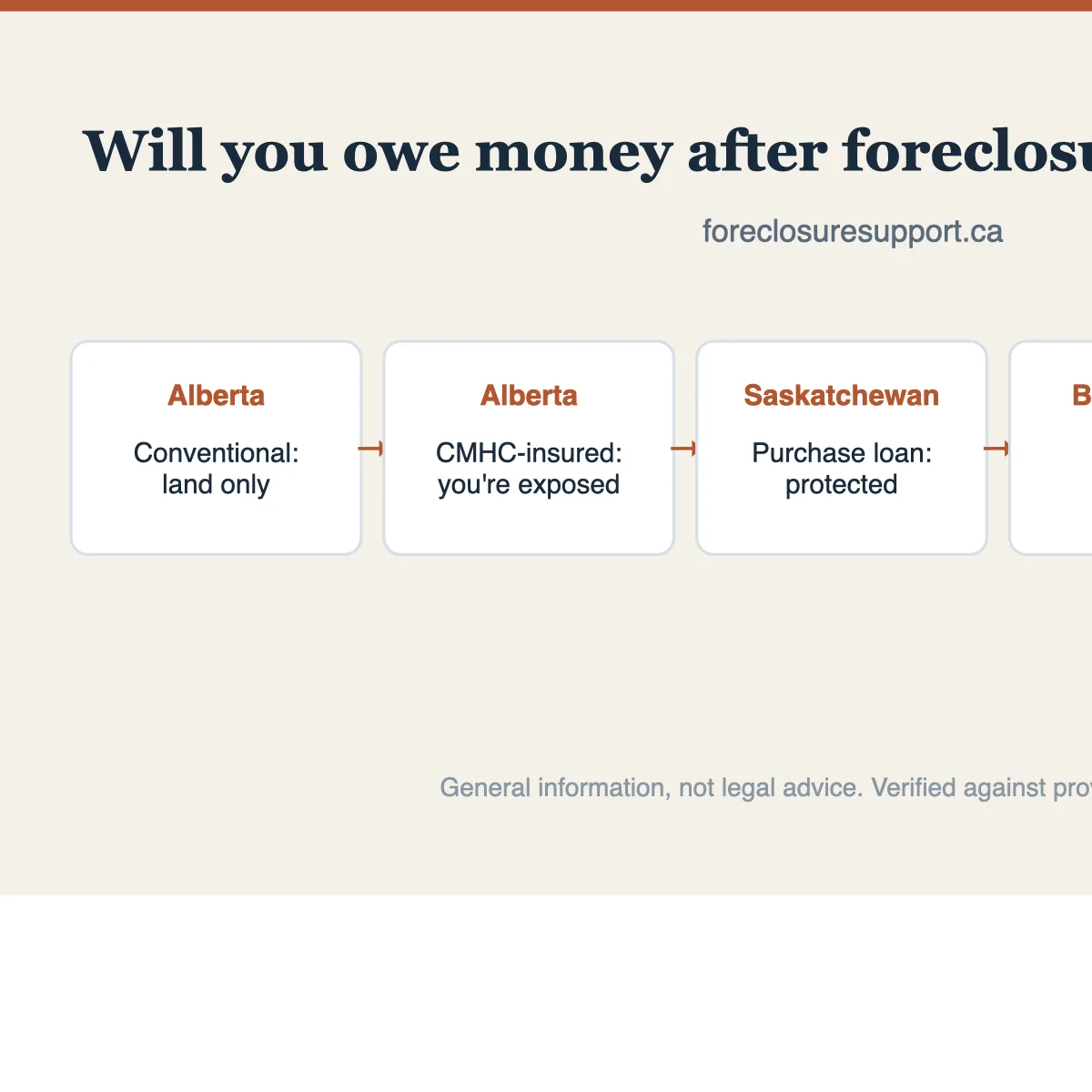
Province by province
| Province | Can they pursue you personally? |
|---|---|
| Alberta | Generally no for individuals on conventional (uninsured) mortgages — recovery is limited to the land (Law of Property Act). Yes if the mortgage is high-ratio CMHC-insured: the insurer can pursue the shortfall. |
| Saskatchewan | No if the mortgage financed the purchase of your home (Limitation of Civil Rights Act) — but refinances and home-equity lines are not protected, and there is no CMHC exception either way. |
| BC | Yes — deficiency claims are available after a court-ordered sale. |
| Ontario | Yes — any shortfall after a power-of-sale can become a personal claim. Any surplus, though, belongs to you. |
| Manitoba | Depends on how the sale proceeds; get advice early — most Manitoba sales run administratively through the land titles registrar. |
| Quebec | No if the lender takes the property "in payment" — that extinguishes the debt entirely. Yes if the lender instead sells it and a shortfall remains. |
| Atlantic | Yes in NS and NB (claims assessed in the court action); possible in NL and PEI. |
These are the general statutory rules — individual files vary, and your own lawyer confirms how they land for you.
Why your mortgage paperwork matters more than you think
Two Alberta neighbours can walk away from identical foreclosures with completely different outcomes: one owes nothing further because their mortgage was conventional; the other faces a six-figure claim from the mortgage insurer because theirs was high-ratio and CMHC-insured. Same street, same price drop, opposite endings. Before making any decision — walking away included — find out which mortgage you actually have. It's on your original mortgage documents, or one call to your lender.
The same trap exists in Saskatchewan in a different shape: the protection covers the mortgage that bought the house. If you refinanced or opened a home-equity line, that new debt is fully collectible even though the original purchase loan wasn't. We explain the Saskatchewan process — including the 60-day leave-of-court notice most provinces don't have — in the Saskatchewan guide.
The one move that shrinks the risk everywhere
Forced sales bring below-market prices in every province — sheriff's auctions and court-ordered listings routinely clear 15–25% under market. A lower sale price means a bigger shortfall, and a bigger shortfall means a bigger potential claim against you. Selling privately, earlier, at a real market price is the single most reliable way to shrink or eliminate a deficiency — and if there's equity, it puts the surplus in your pocket instead of leaving it to erode under legal fees. Run your own numbers with the cash calculator.
Quick answers
Does CMHC insurance protect me in a foreclosure?
No — it protects the lender. If your high-ratio mortgage was CMHC-insured and the sale leaves a shortfall, the insurer pays the lender and can then pursue you for the difference.
Can the bank take more than the house in Alberta?
For individuals on conventional uninsured mortgages, generally no — Alberta's Law of Property Act limits recovery to the land. CMHC-insured mortgages don't get that protection.
What happens to money left over after a forced sale?
Any surplus after the debt, interest, and costs are paid belongs to you in every province. Costs compound the longer the process runs, which is why acting early protects equity.
Talk it through with a person
Every situation above has a version where you keep the house and a version where you sell well — a free 15-minute call maps yours. No fees, no pressure, and if the right answer doesn't involve us, we'll say so.
Alberta foreclosure guide → Saskatchewan foreclosure guide → Ontario power-of-sale guide →
Keep reading
- What happens if you miss a mortgage payment in Alberta?
- How selling to a cash buyer actually works
- Power of sale, explained
Sources
- Law of Property Act, RSA 2000, c L-7, ss. 40–44
- Limitation of Civil Rights Act, RSS 1978, c L-16 (Saskatchewan)
- Civil Code of Québec, arts. 2778, 2782