Foreclosure Support › Questions
How selling your house to a cash buyer actually works
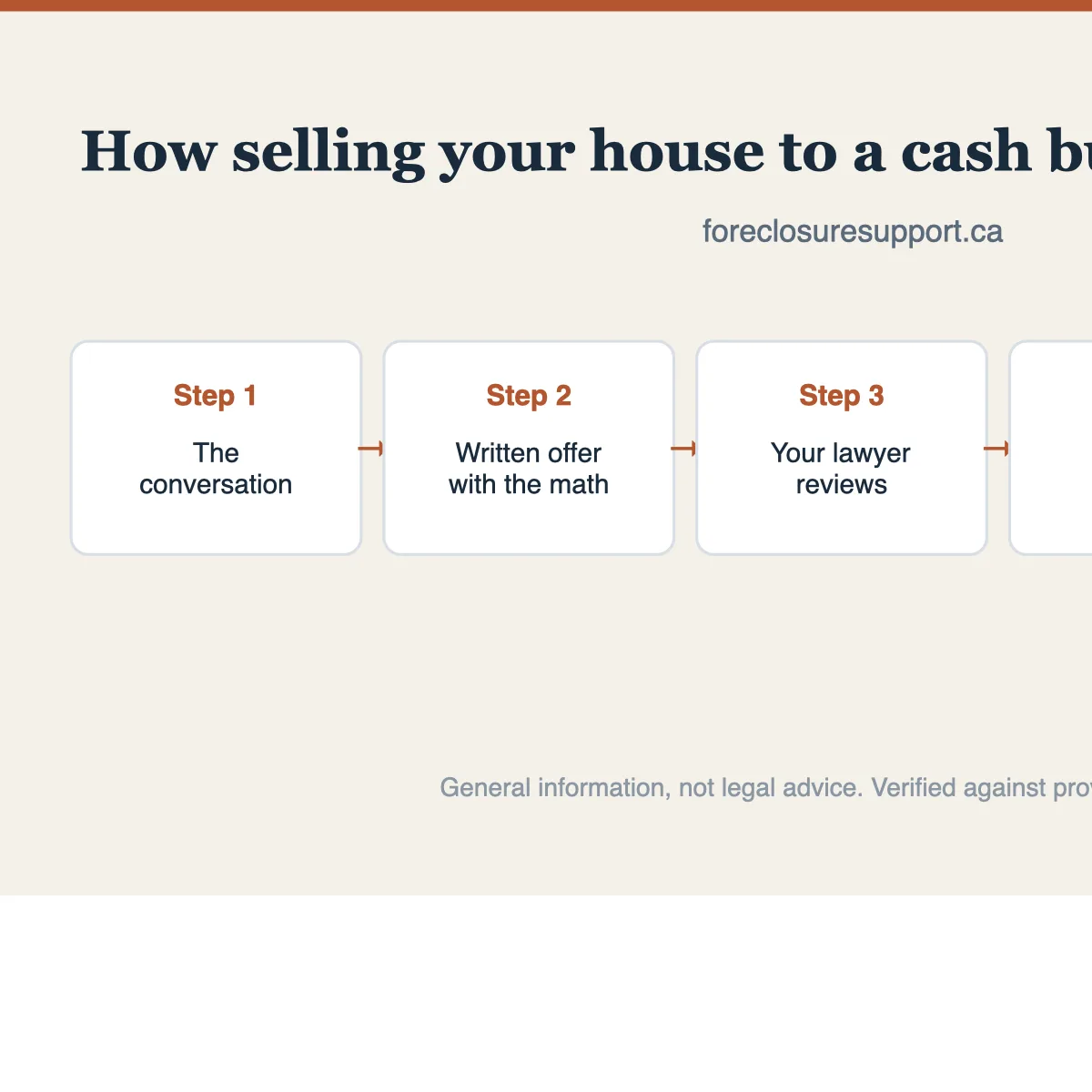
The five steps, honestly explained
- The conversation. You describe the property and your situation — condition, what's owed, your timeline. Ten to fifteen minutes, free, no obligation.
- The offer. A serious buyer shows you the math, not just a number: what the house is worth in good condition, minus repair costs, minus their margin. If the math isn't shown, ask for it.
- Your lawyer reviews. Every document goes through a lawyer representing you. A legitimate buyer insists on this — it protects both sides. If a buyer discourages you from getting legal advice, walk away.
- Closing on your date. Cash sales can close in about a week when a deadline is bearing down, or months out if you need time. You pick.
- The payout. Your mortgage and any liens are paid from the proceeds at closing, and the rest is yours. If a foreclosure was underway, the sale ends it.
Can you stay in the house after selling?
Sometimes, yes. Sellers often need weeks after closing to pack, find a rental, or line up the next chapter — and a possession date after the closing date, or a short rent-back arrangement, can often be written into the deal. It's one of the most common requests we hear, and it's negotiable like everything else. Ask for it up front and get it in the written agreement, never as a handshake.
What about your equity — and the fees that eat it?
If a foreclosure is running, your payout statement grows almost weekly: legal fees, per-diem interest, and process costs get added to what you owe and come out of your equity before you see a dollar. This is why two payout statements a few weeks apart can differ by thousands. Selling earlier freezes that erosion — the difference between acting in month one and month four is often the difference between leaving with real money and leaving with nothing. The calculator shows the three scenarios side by side.
And one more honest note: a cash sale is not always the right answer. If your income has recovered and the arrears are catchable, reinstating or refinancing may beat selling — a serious buyer will tell you so. That's the conversation the first call is for.
Quick answers
Do I need a lawyer to sell my house to a cash buyer?
Yes — and any legitimate buyer will insist on it. Your own lawyer reviews every document before you sign. Treat any buyer who discourages independent legal advice as a red flag.
How fast can a cash sale close in Canada?
About a week at the fastest, when a court deadline is bearing down — or on whatever later date suits you. The date is negotiable; that flexibility is much of the point.
Can I sell my house if it's already in foreclosure?
Yes, in every province — up until the forced-sale process completes. A sale that fully pays out the lender ends the proceeding, and any surplus belongs to you.
Talk it through with a person
Every situation above has a version where you keep the house and a version where you sell well — a free 15-minute call maps yours. No fees, no pressure, and if the right answer doesn't involve us, we'll say so.
How our process works → The cash calculator — three scenarios → Foreclosure help in Winnipeg →
Keep reading
- Missed a mortgage payment in Alberta? The real timeline
- Will you owe money after foreclosure?
- Foreclosure terms in plain English